

AL5B Arm Assembly Instructions Rev. 2.1
AL5B Arm Assembly Instructions Rev. 2.1
Updated December 2014
Safety first! Wear eye protection and never touch a powered robot!
This guide shows how to assemble the AL5B arm with either the SSC-32 or the SSC-32U servo controller. Calibration can be done using: SSC-32 Servo Sequencer Utility · RIOS (purchased separately or as part of a kit) · Lynxterm (legacy software)
Note: Loctite / thread lock can be used on aluminum components, though not necessary if nuts are properly tightened. Do not use on Lexan or plastic parts.
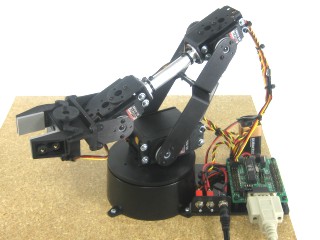
Complete arm (SSC-32 shown).
The Lexan pieces have a protective covering that must be removed before assembly. The laser cut melts the covering into the cut edge. Gently scrape the cut edge with a flat blade screwdriver to lift and peel the covering off. On smaller pieces, use duct tape after scraping. For further information on Lexan, see this page.
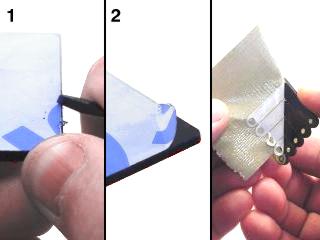 Lexan Preparation.
Connect the "C" bracket to the large "C" bracket as shown using two 2-56 x 1/4" screws and 2-56 nuts.
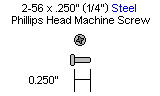
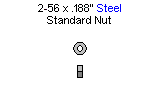
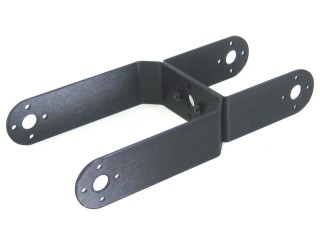 Figure 1.
Install the mechanical dampening panels as shown using four 2-56 x 1/4" machine screws. Add the discs to the correct side and ensure the Lexan protective covering has been removed. Press down when screwing to ensure no gap between Lexan and aluminum.
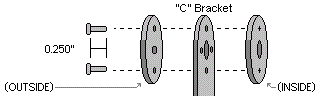
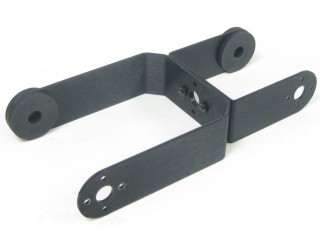 Figure 2.
Insert the 4-40 x .5" Phillips head screw through the hole in the multi-purpose bracket as shown. Secure with a steel nut.
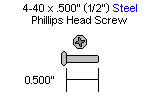
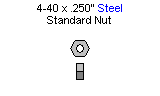
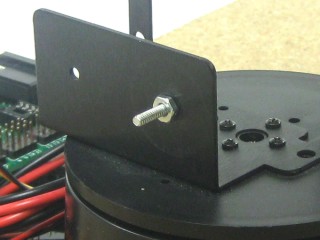 Figure 3.
Slide the large "C" bracket end of the bracket assembly over the screw and secure with a nylon insert lock nut. Start loose — tighten only if the arm wobbles. Caution: do not over-tighten! If the dampeners are too tight the servo WILL heat up and CAN be damaged!
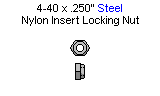
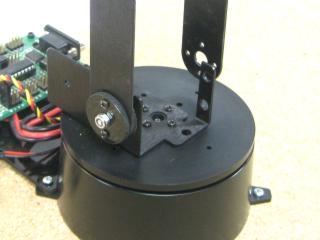 Figure 4.
Replace the black servo horn on the HS-755HB mega servo with the round nylon servo horn. Remove the servo horn screw without rotating the horn, pull it off, press the nylon horn in place as close to the alignment shown as possible, and replace the screw. The arrows point to the screw holes you will use.
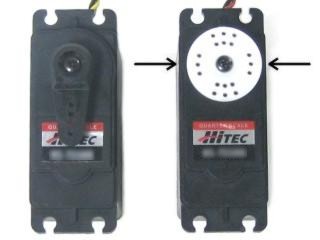 Figure 5.
Attach the HS-755HB servo to the base bracket using the 3mm hardware per the diagram below. Use two #2 x 1/4" tapping screws to secure the bracket to the servo horn. Route the shoulder servo wires underneath the servo. Plug the servo into channel 1 on the SSC-32. Rotate the base to an extreme and use a wire tie to take up cable slack.
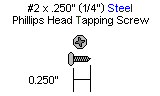
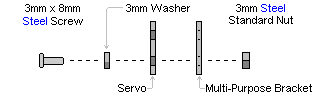
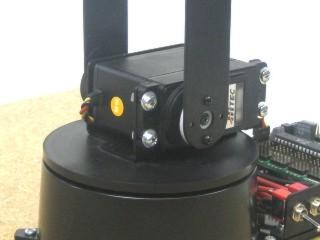 Figure 6.
Attach two tubing connector hubs to the short side of the "L" brackets using four 2-56 x .250 screws and 2-56 nuts (two each).
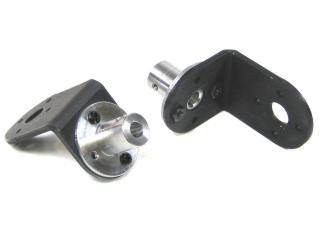 Figure 7.
Connect the hubs to the 2.25" tube using two 4-40 x .250" screws. Tighten firmly.
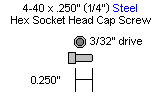
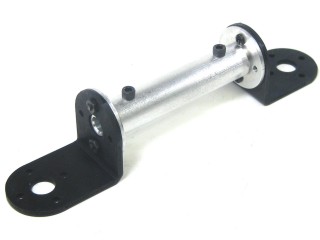 Figure 8.
Attach the tubing structure to two Multi-Purpose brackets as shown using four 2-56 x .250 screws and 2-56 nuts (two each).
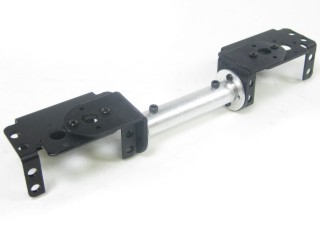 Figure 9.
Insert the 4-40 x .5" Phillips head screw through the hole in the multi-purpose bracket as shown. Secure with a steel nut.
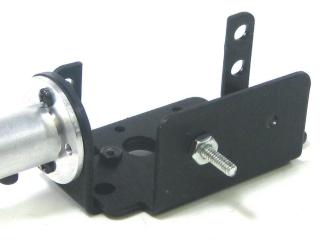 Figure 10.
Slide the screw on the forearm assembly through the dampening discs and secure with a nylon insert lock nut. Start loose and tighten only if the arm wobbles. Caution: do not over-tighten! If the dampeners are too tight the servo WILL heat up and CAN be damaged!
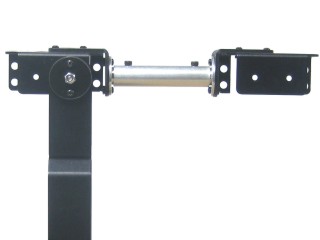 Figure 11.
Verify that your standard-size servo output horn is at center position as shown. The arrows point to the screw holes you will use.
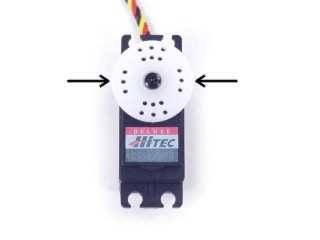 Figure 12.
Attach the HS-645MG elbow servo to the bracket using the 3mm hardware per the diagram below. Use two #2 x 1/4" tapping screws to secure the bracket to the servo horn. Route the elbow servo wires over the servo. Plug the servo into channel 2 on the SSC-32.
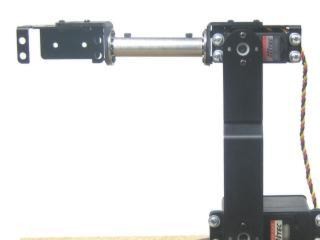 Figure 13.
Attach the Little Gripper connector to the short "C" bracket using two 2-56 x .250" screws and 2-56 nuts.
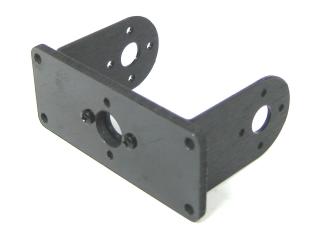 Figure 14.
Attach the short "C" bracket to the other Multi-Purpose bracket as shown. Refer to the diagram below for detailed ball bearing installation information.
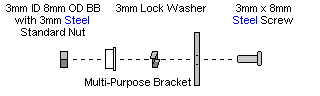
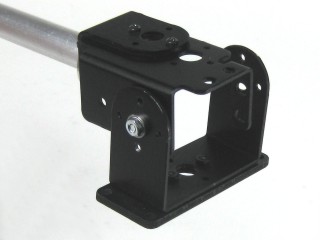 Figure 15.
Attach the HS-485HB wrist servo to the bracket using the 3mm hardware per the diagram below. Use two #2 x 1/4" tapping screws to secure the bracket to the servo horn. Route the wires over the servo.
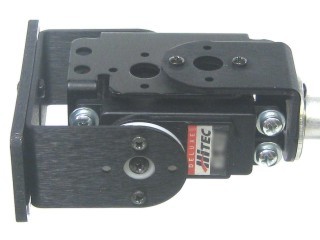 Figure 16.
Step 17: Attach the Little Grip to the Lexan using three 4-40 x .375" button head screws and acorn locking nuts (three only — the gripper servo body blocks the fourth). Align the HS-422 servo to mid-position with the gripper halfway open. Remove the servo screw and horn, slide the servo in from the bottom, reseat, and replace the screw. Tighten then unscrew half a turn — too much friction can bind the servo.
Step 18: Add a 12" servo extender cable to the gripper servo and a 6" extender cable to the wrist servo.
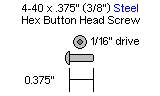
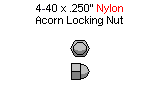
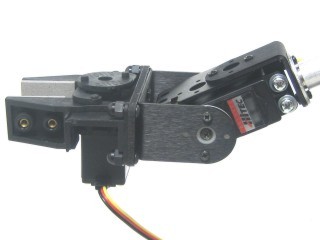 Figure 17.
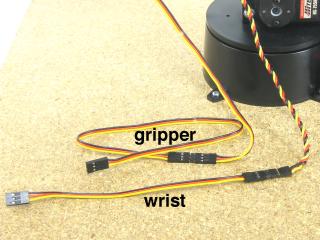 Figure 18.
Carefully bend the wrist servo back as far as it will go and use wire ties to secure the servo cables as shown. Leave slack in the gripper servo cable — do not pull too tight.
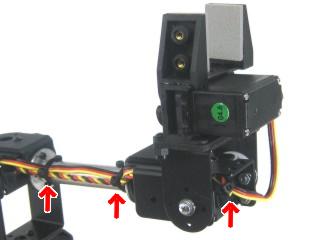 Figure 19.
Carefully stretch the arm forward as far as it will go and use wire ties to secure the cables. Leave slack — do not pull too tight. Plug the servos into the SSC-32 according to Table 20.
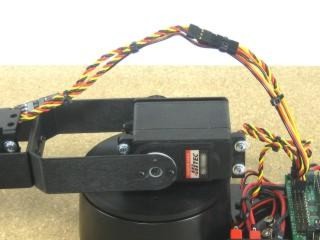 Figure 20.
SSC-32 Servo Channel Assignments (Table 20)
| SSC-32 Ch. | Servo |
|---|---|
| 00 | Base |
| 01 | Shoulder |
| 02 | Elbow |
| 03 | Wrist |
| 04 | Gripper |
| 05 | Wrist Rotate (optional) |
SSC-32 (Serial) — Step 21a
Download and install LynxTerm. Connect the SSC-32 to the serial port and apply power. The green LED should light up. Run LynxTerm. Consult the serial troubleshooting guide if needed. Select each channel 0–4 and test carefully using the slider bar.
SSC-32U (USB) — Step 21b
Download and install the SSC-32 Servo Sequencer Utility. Connect the USB cable and power the board. Set baud rate to 9600. The software auto-detects the COM port with FTDI drivers. Ensure servos 0–4 are checked, then use the sliders to verify each servo. See the SSC-32 Servo Sequencer Utility manual for more information.
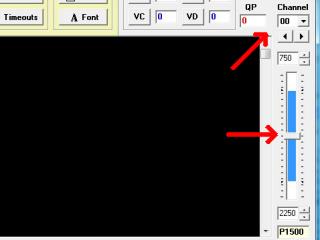 Figure 21a (LynxTerm).
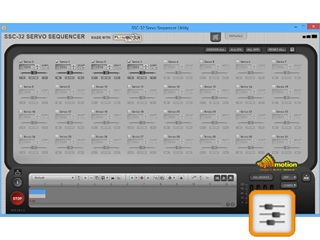 Figure 21b (SSC-32 Utility).
SSC-32 (Serial) — Step 22a
Click "All = 1500" in LynxTerm. The arm should look like Figure 22. If any joint is off by more than 15°, check your assembly. If you did not purchase RIOS, proceed to Step 27.
SSC-32U (USB) — Step 22b
Click "Calibrate" in the SSC-32 Servo Sequencer Utility. Knobs appear next to each servo — click and drag up/down to fine-tune until the arm matches Figure 22. Once all servos are positioned correctly, click "Calibrate" again to store the offset values. If you did not purchase RIOS, proceed to Step 27.
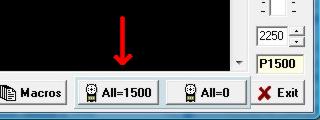 Figure 22a (LynxTerm — All=1500).
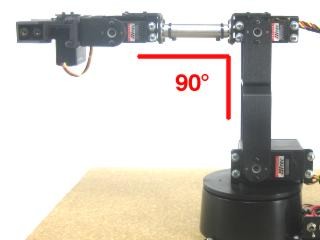 Figure 22 (target position).
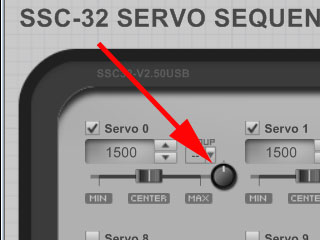 Figure 22b (SSC-32 Utility calibrate).
Remove the servo horn screw from the elbow servo. Pull the horn off, lift the arm two clicks (30°) at the elbow, and reattach the horn and screw. Note: the Hitec spline has 24 grooves — each groove is 15°.
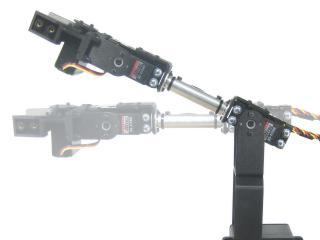 Figure 23.
Install RIOS following the on-screen prompts. The serial number is on the back of the CD sleeve. Use the RIOS Help File (Steps 1–7) to calibrate and use the arm. Perform an accurate calibration — if the on-screen virtual arm does not match the real arm, the calibration is inaccurate. Study the RIOS manual to learn how to store and playback sequences.
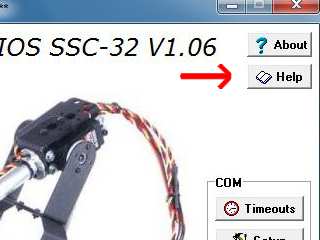 Figure 24 (RIOS).
To calibrate the arm's Shoulder servo, click the "SSC-32" button in RIOS.
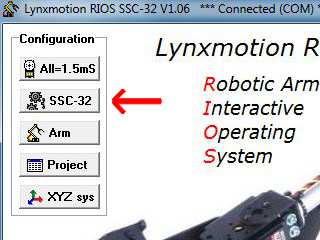 Figure 25 (RIOS).
Select Shoulder servo #2. Move the slider up (forward) until it looks like Figure 26-2. Set Min Deg to -90° and right-click the slider to set as Min Position.
Move the slider down (backward) until it looks like Figure 26-3. Set Max Deg to 90° and right-click to set as Max Position.
Read the RIOS users guide (Help icon on main screen or C:\Program Files\RIOS_SSC-32\Help.pdf) for full usage instructions.
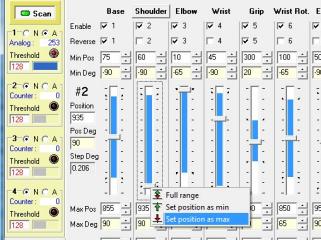 Figure 26-1 (RIOS).
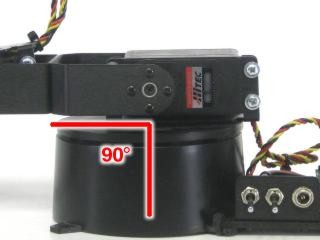 Figure 26-2 (Shoulder at -90°).
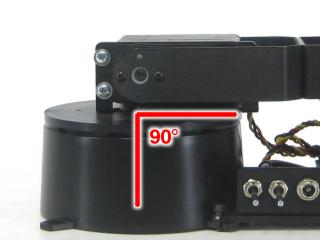 Figure 26-3 (Shoulder at 90°).
To connect springs for load-balancing, replace the servo attachment hardware in the locations shown, following the diagrams below. Hook the springs together after they're secured.
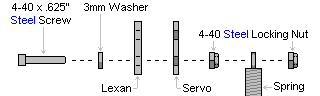
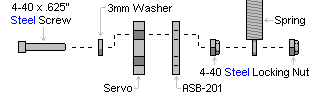
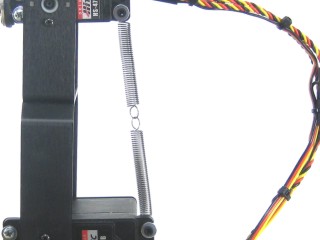 Figure 27.
The arm assembly is complete. The arm is mechanically robust, but servos can be damaged by improper use — commanding an unobtainable position, crashing the arm into itself or other objects. The elbow servo is most vulnerable as it bears the full forearm weight. Load-balancing springs reduce this load.
If you purchased FlowBotics Studio, FlowStone, or FlowArm, proceed with the instruction guides associated with those programs.
Important: People do not like holding heavy objects with their arms outstretched. Servo-based robot arms don't either. The most important rule: Park the arm when not in motion! When moving or at rest it is usually fine. When holding an object, do so for the minimum time required. You can always touch the servo case to check if it is getting hot.